The Honda CBF Stunner
is a new slant at the executive 125cc category- melding commuter-friendliness with
sporty style with a exclusive power. The bike is aimed basically for the
college going students and young-professionals alike who would like to ride
economically but still make a style statement. The Stunner is also a testament
to the Honda’s refined engineering that’s manifest in the bike’s smooth and
sporty performance. The bike takes a outclasses to it’s two other rivals that
is the sporty Yamaha Gladiator and the streets friendly TVS Flame to come out
as champion in the sporty executive class.
Performance
Head light
Like all
Honda bikes the Stunner is smooth yet strong and confidently pulls away with a
twist of the wrist; its engine is made for refined to a very high degree
indeed. The Stunner’s power plant is derived from one on the older Honda Shine.
It has been tweaked a bit but what is really makes a difference to the
performance is the new 5-speed gear box which offers taller gear ratios and
hence less jumpy performance. The bike also offers a commuter-friendly spread
of torque in the lower rev and mid rev range which is where the engine will
mostly be running at. This is translates into a good pickup from start to go.
In numbers the 125cc mill pumps out a cool 11bhp @ 8000rpm, making this bike
most powerful in the executivecategory. Finally, the most important there is a
fuel injected variant of the bike, PGM FI that offers a better throttle
response than the carbureted version of bikes. Other performance bike figures
are pretty much the same in both variants though.
Design
Indeed
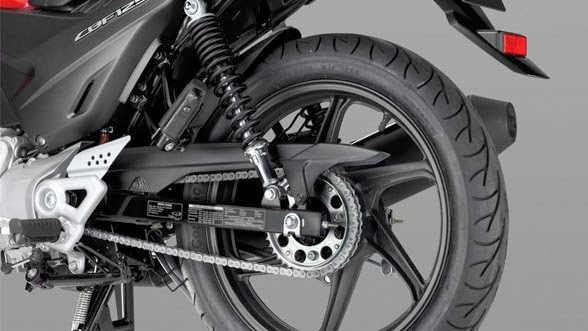
the Stunner’s design is truly ‘stunning’. Like the Yamaha gladiator, Honda has
brought to the 125cc executive category the oomph of higher capacity machines.
Surely, most people who would have first seen the Stunner would have mistaken
it for a 150cc or even a 200cc bike partly because of the big off-roader style
Bikini fairing which makes the bike bigger than it actually seems. But get
behind the tank and you’ll see a skinny machine that’s clearly over-dressed.
Nonetheless, the integrated front body cowl and step seat look great from a
third person point of view. Other sporty inclusions are alloy wheels and yellow
painted rear suspension.
Features
& Colours
The bike
features an aerodynamic and sporty bikini fairing smooth performance and
all-round reliability. It is available in two catagories the Stunner and the
Stunner PGM FI. The bike is available in red, yellow, black and silver colour
schemes. The latter is based on the CBR1000RR Fire Blade colour scheme and fuel-injection
with a lot of other minor updates. It seems like a watered down response to the
Yamaha R15 which, like the PGM FI, is based on a bigger race monster, the
1000cc Yamaha R1. The Stunner is available for a street price of around the Rs.
60,000 while the PGM FI will be available for over the Rs. 70,000 in most
cities which may seem like a too high price.
Asingle-cylinder engine is a basicpiston engineconfiguration of aninternal combustionengine. It is oftenmotorcycles,auto rickshaws,motor scooters,mopeds,dirt bikes,go-karts,radio-controlled models and has many uses in portable tools andgarden machinery. It has been used in theautomobilesandtractors.
Characteristics:
Single-cylinder engines are simple and compact and will be often deliver in the maximumpowerpossible within a given envelope. Cooling is simpler than with multiple cylinders, potentially saving further weight, especially if air-cooling can be used. Single-cylinder engines require more flywheel effect than multi-cylinder engines and the rotating mass is relatively large, restricting acceleration and sharp changes of speed. In the basic arrangement they are prone to vibration though in some cases it may be possible to control this withbalance shafts.A variation known as thesplit-singlemakes use of two pistons which share a single combustion chamber.
Pros and cons:
Single-cylinder engines are simple and economical in construction. The vibration they generate is acceptable in many applications, while less acceptable in others. Counterbalance shafts and counterweights can be fitted but such complexities tend to counter the previously listed advantages. Components such as the crankshaft of a single-cylinder engine have to nearly as strong as that in multicylinder engine of the same capacity per cylinder, meaning that some parts are effectively four times heavier than they need to be for the total displacement of the engine. The single-cylinder engine will almost inevitably develop a lower power to weight ratio than a multi-cylinder engine of similar technology. This can be a disadvantage in mobile operations, although it is of little significance in others and in most stationary applications.
Uses:
engine
Early motorcycles, automobiles, other applications such as marine engines all tended to be single-cylinder. The configuration remains in widespread the use inAuto rickshaws,motor scooters,dirt bikes,go-karts, mopeds areradio-controlled modelsand is almost exclusively used in portable tools, along with garden machinery such aslawn mowers.
The bestselling motor vehicle of the world, theHonda Super Cub has a very fuel-efficient 49 cc single-cylinder engine and big-diameter 17-inch wheels. Somemotorcycleswith strong single-cylinder engines are available today. There aresport-bikeslike the KTM 690 Duke Rwhich has 70 hp 690 cc single-cylinder engine and reaches 125 mph (200 km/h) with a curb weight of only 150 kg,dual-sport motorcycleslike the BMW G650GS as well as classics like theRoyal Infield 500 Bulletwith a long-stroke single-cylinder engine.
Euro Spec Honda CBR250R revealed
Apart from the CBR150R pictures (with specs and other details) that we showed you earlier, the pictures and details of the soon to be released CBR 250R have also been spilled on the internet. The pictures were published by a European newspaper. We are not sure whether this exact same bike will make it to the Thai or Indian market, but it’s set to make debut in the European market for sure and give the Ninja 250R a must be good run for its money. Very honestly, after this revelation, we cannot be sure whether the smaller CBR150R or this one is coming to India but something is cooking at HMSI for sure, as is told to us by some of our insider friends.
The engine specs, going by the picture and details carried along with the article point at 249cc single cylinder water cooled engine capable of the dishing out a yummy 33bhp of power & weighing 140kg. The newspaper that has published the pictures assumes that the bike will sell for GBP 4000 in the UK which is equivalent to around 2.7 lakh Indian rupees. Going by that price the new bike isn’t going to be substantially cheaper than its head-on competitor the Kawasaki Ninja 250R if and when it arrives in India.
The bikes just like the CBR150R we talked about earlier during the day draws heavily from the VFR1200F for its design. The front end employs telescopic forks while the suspension duties at the rear are undertaken by a monoshock. There are discs both at the front and at the rear. Interestingly, there is an additional ring forming an inner circle within the front disc brake it’s used to measure the wheel rotation speed while applying ABS. We can be sure that the new bike will feature ABS.
The new CBR250R just like the CBR150R features a split seat, which seems rather usable by a pillion rider. The seating position will be racy with rear-sets positioned rather behind.
Now since we have seen the pictures of this new bike as well, we cannot be sure whether it’s the 150 or the 250 CBR that Honda plans to launch in India. One thing is for sure though, they have something exciting up their sleeves, as is evident from the murmurs we have heard from our sources. Watch this space out, as we go all out and try and bring some more detailed information about the CBR150R and CBR250R the two hottest bikes from the Honda stable which great significance for India.
Racing Classes:
Off road
Enduro, Hare scrambles, Motocross, Rally raid, Track racing.
TheHONDA CBR250R(model Honda MC41) is asingle cylinder one of the sport
bikemade byHonda. It was primarily intended for The Thai and Indian
markets, but it is sold worldwide, including thedevelopment countriesin Europe, North America and all over the world.
Regional markets
Indeveloping countrieswhere typical motorcycles are
125–150 cc displacement, the larger 249.5 cc CBR250R is at the higher
end of the sport bike range,looking
similar to much more powerful sporting machines with itsfull fairingin Honda's new layered style that was
introduced on the 2008CBR1000RR
Firebladeand 2010VFR1200F.In better industrialized countries, the
CBR250R enters at the opposite end of the market, as a budget priced beginner
or utility bike, practical and fuel efficient, but with limited sporting
pretensions.
Design
The CBR250R
closely follows the style of the VFR1200F, notable for its Y-shaped headlight
& prominent middle cowl, which creates a layered look which
attraction to the heart of young stars. This new direction in Honda design
debuted at Intermoted in 2008 with the V4
Concept Model and the 2008 CBR1000RR
Fireblade. Motorcycle Consumer
News design columnist Glynn
Kerr observed that new direction in the bike
designs fits the pattern of motorcycle trends imitating but lagging behind, car
styling, in that motorcycles are shifting away from sharp, "lithe",
dart-like shapes of the 2010s toward a heavier, "chunky" style with a
higher, blunter in car nose and a "high waisted" middle with short
windows and thicker pillars. Kerr cites
the Chrysler
300 as the best example, as well as smaller cars
like the Suzuki Swift and Audi A3, commenting
that, “aggression now comes from appearing strong and assertive, rather than
light and dart-like....... the arrow has been replaced by the hammer.”
In motorcycles this translates into
heavy front, reverse rake angle headlight and the use of little or no color on
the rear half of the bike to spotlight the wonderful front one-fourth of the
bike. In this aspect, Kerr also sees influence from the 1991 Yamaha TDM850 and Honda's DN-01 of
2005. On the 2008 CBR1000RR
Kerr thought the dominant vertical line produced an awkward, top heavy look
that played against traditional race replica styling of body lines sloping
downwards towards in the front. The 2010 VFR1200F was visually more successful
because the updated style better suited the greater proportions of a touring
motorcycle and in spite of Honda's third iteration of
the style being a much smaller bike nonetheless Kerr said, "the latest CBR250R carries the look even better than its big
brother." The Ottawa Citizen's review by David Booth said the CBR250R
looked better than the VFR1200F as well commented that, “Where the various
bulges of the big VFR are a little too Jessica Rabbit-like over-the-top, the little CBR250R
styling is far more subtle and really looks the classier of the two.”
Critical reception
Reviews of the CBR250R generally
rate its performance in comparison to its main competitor which in the United
States and Canada is the Kawasaki Ninja 250R.TheHyosung
GT250 and rebadged as theATKGT250 for 2011, is also a potential
competitor in those markets, although it fares poorly in comparison.In India the Ninja 250R andHero Honda Karizma Rare the leading competition.Though
lower in peak power and with a slower top speed than the Ninja 250, the CBR was
lauded for having more than torque available at lower engine speeds, meaning
that it was easier to accelerate from low speed & pulling away required
less noise and drama, since the Ninja had to be revved to 9,000 rpm and
above to make use of its greater power.This made the CBR250R more pleasant and
forgiving to ride than the sportier but
more challenging, Ninja.Complaints fromThe Economic TimesofMumbaiincluded a tendency to stand up if the rider
makes a sloppy mid-corner correction, and brakes and suspension not up to the
standards of a track bike.The
Indian reviewer also perceived the 161 kg (355 lb.)wet weightas
"not so light", while American journalists considered it a
featherweight, "incredibly agile, flickable...almost
too light," at 16.5 lb. (7.5 kg) lighter than the Ninja 250R. The
Ninja 250R's brakes had a better and more linear feel with stronger initial
bite and could stop from 60 to 0 mph
(97 to 0 km/h) in 121.5 ft. (37.0 m), while the
CBR250R, with a stopping distance of 123.4 ft. (37.6 m), was lauded
for its combined anti-lock brake option, a boon to beginners in spite of the
slightly shorter braking distance achievable on the Ninja 250R by a skilled
sport rider.Kevin Ash, at 6 ft. 3 in (1.91 m), was found the
dimensions comfortable for someone of his height, while David Booth cautioned
it could be cramped for taller riders.
In one head to head comparison,Motorcycle USA owners judged
the Ninja 250R to be the better bike due to its superior speed and easy to
handling.The
testers atMotorcycle
Consumer News wasfound the
CBR250R to be the better choice, given the needs of its presumed prospective
buyers in the US, beginners and those looking for a practical motorcycle for
long commutes state that, though "if sheer performance is all you're
after" without regard for fuel efficiency, then the Ninja 250R might be
preferable.
Production
The production of the model was
unveiled in the Thailand International Motor Expo 2010 on the November 27,
2010,Hong
Kong's Central District on the November 28, 2010and EICMA 2010 Global models of the CBR250R
were produced by Thai Honda Manufacturing in the Thailandwith sales beginning in the November 2010
followed by spring 2011 in Japan. Indian and South America models were produced
byHMSIin India beginning in the spring of 2011.
Specifications
Oil/air cooled, 249cc, Single, DOHC
Power: 25.97 HP (19.1 kW) @ 8500 rpm
Torque: 23 Nm (2.35 kg-m) @ 7000 rpm
Final
drive: Chain
Curb
weight: 161 kg
Category: Supersport
Tags: All-rounder, Supersport
Engine and transmission
Engine
1 cylinder. 4-stroke. single
Displacement
249cc(15.21cubic inches)
Bore × stroke
76 mm × 55 mm ( oversquare - shortstroke)
Cooling system
Oil or air cooled
Power
25.97 HP (19.1 kW ) @ 8500 rpm
Torque
23Nm(2.35 kg-m)@7000rpm
Throttle
Cable operated
Valves.
Valves train
Valves per cylinder
DOHC, variable
4
Fuel & ignition
Sparks per cylinder
Fuel supply system
Ignition type
1
Fuel injection
Digital CDI
Compression
10.7:1
Engine mounting
Transverse
Lubrication system
Wet sump
Gear box
Manual 6-speed
Clutch
Wet. Multiple discs and cable
operated
Final drive
Chain
Starter
Electric start
engine-honda-1
engine-honda2
engine-honda-3
engine-honda-4
engine-honda-5
Dimensions
Length
Width
Height
2035 mm
720mm
1125 mm
Wheel base
1370 mm
Trail
95 mm
Ground clearance
145 mm
Seat height
780 mm
Curb Weight
161 kg
honda-headlight
honda-seat
tank
headlight
seat2
seat-wheel
Chassis and suspension
Frame type
Stell.Double cradle frame
Suspension
Fork angle
Brakes
Cartridge – upside – down
25 degree
Twin Disk.296 mm
Suspension
Brakes
Momo shock. Swingarm
Disk. 220 mm
Other
ABS available
No
Power-to-weight ratio
0.12 HP/kg (8.43 kg/HP)
Fuel capacity
13 litre
Number of riders
2 persons
HONDA CBR250R PRICE
LIST IN KOLKATA:
VARIANT EX-SHOWROOM
Honda CBR250R STD Rs.
1.63 Lakh.
Honda CBR250R STD Pearl Sunbeam
White Rs. 1.64 Lakh.
Honda CBR250R ABS Rs. 1.83 Lakh.
Honda CBR250R ABS Pearl Sunbeam
White Rs.
1.94 Lakh.




.jpg)


.jpg)
.jpg)
.jpg)
.jpg)
.jpg)
.jpg)


.jpg)
.jpg)
.jpg)


